


It’s June 12, Anthropic has to switch off the two most powerful models ever created, Fable and Mythos, for every customer on the planet. It’s not because of an outage. And it’s not a bug. No, an US export-control directive landed, and within hours the models were gone for everyone. If your business was running Fable in production, it was just killed in its tracks.
Just pause at that thought for a second.
The last three years we’ve seen coding agents go from tab-complete to colleague. It started with Cursor, then Claude Code, then Devin and the rest. It’s the fastest shift in engineering that we have seen in history. But what I notice is that most people still file these tools under “assistant”, a smarter pair of hands that live next to the developer.
Frankly, in my opinion that framing is already out of date. Because the next thing is already here: and it’s the software factory.
I define a software factory as an assembly line of agents. Some off-the-shelf like Claude Code or Codex, some built in-house, and they are usually a mix. What makes it a factory is the same thing that makes a real assembly line a factory: it’s designed with engineering principles. You can watch it run. You can see what each station in the assembly line is doing and where the line jams.
The critical difference between an assistant and a production process
The implications of going from an assistant to a factory cannot be understated. I view an assistant as a convenience. A production line however, that is mission-critical for a business. The moment your software gets built by a factory, the factory becomes mission-critical infrastructure, and in my view: you don’t rent your infrastructure from people who can repossess it overnight.
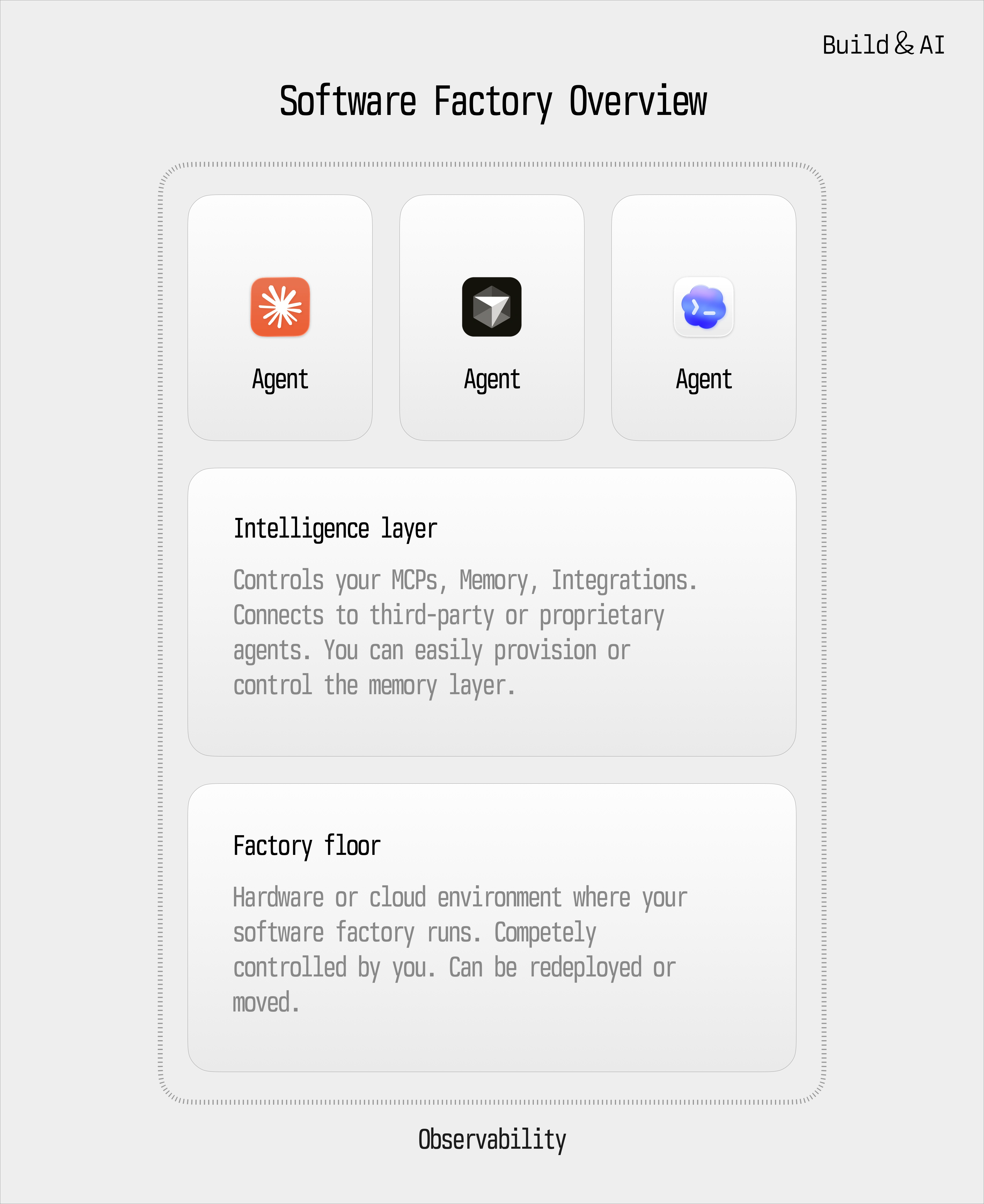
So if you’re going to run a software factory, you should own it. With three layers, specifically.
Own your intelligence layer
Skills, MCPs, memory, integrations, they are the elements that make an agent actually good at your work. Every frontier lab is racing to group these into its own stack, and not without reason: they are the lock-in. It’s the value that you bring on top of the raw model intelligence. Owning your intelligence layer means you provision and control these elements yourself: which tools an agent can reach, what context it carries, what it’s allowed to remember, what skills it can access and where they are hosted. The model or harness becomes a part that you can change or replace and, critically, not a thing your whole operation depends on.
Build your own observability layer
Whether the work is done by Claude Code, Codex, or an agent you wrote yourself, you need to see inside the assembly line. What is each agent picking up? Is it doing the work you actually asked for, or its own interpretation of it? Where is it going off the rails? A good observability layer answers that at two levels: drill into a single agent, or watch the health of the whole system. And ideally, it’s adapted for your business and tech stack to highlight what’s most critical for you.
The factory floor is yours
The factory floor is where all of your agents work. That can be your own cloud, your on-prem, your own hardware or your local computer. I want to underline the importance of ownership here: you must have full control over where the factory floor is hosted and who and what has access. I think that moving forward, it’s non-negotiable that you are in control over where your agents work.
Which brings me back to June 12, last week. These models were not pulled by a hacker, or a breach. It was a legal directive, aimed at real people like you and me. Non-US citizens. That cut access in a single afternoon. For reasons that had nothing to do with how well you or any customer behaved. That is the risk of not owning your foundation for intelligence: your access to your own factory can be removed at any time.
To analyse where you stand, I’ve created the following checklist:
Do you control your software factory?
Run this against your own setup. Every line should be a “yes.”
Intelligence layer
You can swap the underlying model without reconfiguring your agents.
You decide which tools, skills, and MCPs each agent can reach, not OpenAI, Anthropic, etc.
Your agents’ memory and context are yours, you can transfer them between agents.
Observability layer
You can reconstruct what any agent did on any task, after the fact.
You can tell whether an agent did the work you asked or its own version of it.
You find out about failures before your users do.
Factory floor
You know exactly where every stage of the pipeline runs.
You could move the whole factory onto infrastructure you control if you had to.
No single external party can cut your line off without you having a fallback.
The fastest version of the test: if Anthropic or OpenAI cut access, what stops working? If the answer is “everything,” you don’t own your factory. You’re borrowing it.